Showing posts with label 4 color cinema. Show all posts

Tuesday, August 19, 2008

4 Color Cinema


Batman: Gotham Knight

Since about the time I was in the fifth grade, DC Comics has always had a solid, well-established foothold in the world of cartoons and animation.  Springing up as the show that would not die (Batman: The Animated Series, although it is always amusing to note that the show was simply called Batman until Fox decided to advertise it as such), and continuing in various forms and formats over the years, the "DCAU" as it is commonly referred to has moved in a new direction in the last few years, pushing more into DTV (or as some technophiles like to say "Direct to DVD") feature films.  The titles released under this new umbrella (Superman: Doomsday, Justice League: The New Frontier, and Gotham Knight) have all had unique art direction and visual styles, setting them up as discrete, individual films rather than as a series adaption or continuation.  Knight ups the ante even further, by bringing in six seperate styles to the film, with each one handled by a different creative team and animated at a different studio.  The result is a sort of "jam" film or psuedo-anthology, with six smaller features adding up to one larger story.  The overall effect, though, is more uneven than anything else, leaving all but the most hardcore viewer disappointed.

The story is roughly that of the intermezzo between Batman Begins and The Dark Knight, as Gotham City continues to suffer from corruption and crime, even as Batman emboldens the citizens and takes the fight to his opponents.  The first vingette is "Have I Got A Story For You," a twist on the classic tale of several kids exchanging thoughts on who or what they think Batman is.  This leads directly into "Crossfire," where officers (Crispus) Allen and Ramirez must escort a prisoner to Arkham, and wind up in (natually) a crossfire between Sal Maroni and the Russian mob.  Batman gets some new technology in "Field Test," in the form of a small electromagnet which can redirect small arms fire, but the test turns out to be a failure during a mission.  "In Darkness Dwells" finds Batman in the sewers of Gotham chasing Killer Croc, only to end up face to face with Scarecrow and his strange brainwashed cult of homeless.  This encounter leaves Bats physically and mentally beaten-up, so he flashes back in "Working Through Pain" to his time in India learning to manage and control his pain.  Finally, Batman must overcome his injuries to stop the assassian Deadshot, who is gunning for Lt. Gordon.

The main problem I have with this film is it's episodic nature which leaves most of the segments unfulfilling.  "In Darkness Dwells," for instance, teases us with Killer Croc only to gives us literally less than a minute with him, since he is not the "purpose" of the segment.  In a similar vain, "Field Test" feels completely unrelated to the other segments, and is almost like a "fill-in issue" in the middle of the movie.  The animation is hit-or-miss for me, but I am not an anime fan so I am not the target audience.  This technique worked better in The Animatrix, which was all "side stories" and didn't try to be a larger narrative.  That method might have been a better choice than the "sum of the parts" technique used here.

The voice acting has always been one of the strong suits of the "DCAU" and that is no exception here.  It's great to hear Kevin Conroy as Bats and Bruce again, and the juxtaposition of his voice and Bale's grumbling in the theatrical films is alarming.  Jim Meskimen evokes Oldham's Gordon without aping him, and his Deadshot is menacing and dangerous.  And who can forget vocal madman Corey Burton, who plays both the Russian and Scarecrow to great effect.  (Interesting side note, evidently Martha Wayne is played in flashback by none other than voice director Andrea Romano.)

On the whole, I didn't care for Gotham Knight.  It didn't serve either of it's primary functions, which would be to first entertain me, and second to get me to want to see The Dark Knight, so I have to deem it a failure on those levels.  But, as I have said, I am not the biggest Batfan in the world, and my taste for anime is very, very limited.  So I am probably not the best litmus test for this film, given it's very specific genes.  If you really like Batman, or enjoy anime and the different art styles, then this may appeal to you.  But it sure didn't appeal to me.

Thursday, July 31, 2008

4 Color Cinema


The Dark Knight

You guys may have heard about a new Batman movie coming out this summer.  Yeah, I know, I was surprised too, although I guess that the last one did good enough business to warrant a sequel.  Unsurprisingly, the villian is the Joker, and there's some Year One-ish stuff with Harvey Dent in there as well.  Anyone else catch this?  It sorta flew under the radar.

...

Ah who am I kidding?  Even a deluded weirdo like me could only keep that gag going for one paragraph!  The Dark Knight, Nolan's even more nightmarish and nihilistic follow-up to Batman Begins, has hit and hit hard, smashing records at the box office and breaking new grounds for darkness and maturity in a Superhero movie.  Any residual taste leftover from the lukewarm (Aside: I used to really hate that word as a kid.  Now I don't mind it.  Anyway.) reception of Superman Returns has been swept away as the the monies are continually poured into Warners' coiffers on the bent back of the Bat-Man.

The story of our film involves Gotham City's new "white knight," District Attorney Harvey Dent, and his crusade to shut down the mob which has controlled the city for so long.  Well, that's the "main" story, anyway.  The "real" story is that self-same mob hiring the bizarre psychopath known only as the Joker to kill Batman, making Gotham safe for their shady operations once again.  But Joker is not some mere hitman -- his plans call for nothing short of anarchy and chaos in the streets, pushing the already on-edge city off the proverbial cliff into barbarism.  Batman has to not only deal with the mob, but also this "wild card" thrown into the mix, all as Bruce Wayne sees any chance of a normal life slipping through his fingers.

So yeah, you can see that Nolan is not exactly producing something Bill Fingerish here.  This is a story about broken people in a broken world, where redepmtion seems impossible and that light at the end of the tunnel really is a train heading for you.  But in this darkness we find that the struggle of a hero is not lost, it's just harder to see.

The script functions as more of a series of setpieces than as a whole -- this is a series of issues in a major storyline moreso than a one-shot -- but as we move from one to the other we get a sense for the hopelessness of the citizens of Gotham as well as the upward struggle it's saviors have to face.  Bale's Batman remains unyielding and intense, without the hesitation he had initially, while his Bruce Wayne is more introspective and contemplative.  Aaron Eckhardt shines (no pun intended) as Harvey Dent, a man who knows he can that he really can't trust anyone, but knows that to do his job he puts himself in the crosshairs.  Dent's driven pursuit of the mobsters of Gotham ably demonstrates his belief in justice, a belief which puts him squarely at odds with the still-overtly-corrupt GCPD.  Dent emerges as one of the true "heroes" of the film.  

The supporting cast all handles things pretty nicely.  Michael Caine doesn't have as much to do as Alfred this time out, but he handles it with aplomb.  Morgan Freeman's Lucius Fox similarly has less to do, but still has a great series of interactions with Bale, refining their relationship to the next logical step.  And what can I say about Gary Oldham as Jim Gordon except that he IS Jim Gordon -- and seeing the character as truly the Only Honest Cop in Gotham is something we don't get to see that much anymore, but shows off why Gordon is such a lasting character.

Maggie Gyllenhaal, taking over the role of Rachel Dawes for Katie Holmes, unfortunately suffers the exact same fate as her predecessor, as Rachel feels tacked on and obligitory; her presence in the film is limited to removeing accusations of the whole affair being a sausge-fest and being a MacGuffin.  Frankly, this character was just plain ill-concieved.  

And yes, the real star in this 4 Color epic is indeed Heath Ledger's insane (or perhaps, "hyper-sane?") Joker, a harsh and mean-spirited clown in the most evil sense of the word.  His constant ticks and twitches keep the audience's eyes on him whenever he is on screen, and his constant twisting of phrases in his delivery and unpredictable behavior makes him the obvious focus.  The inspiration for this take on the Joker comes from all over the board -- liberal amounts of Killing Joke, for example, but also Arkham Asylum -- and the result is one of the most visually and psychologically arresting film villians since the debut of Jigsaw (whom, most fans will not want to admit, this Joker shares some characteristics with).  He pushes everyone around him to the edge, whether they are his allies or not, because he has no allies.  His side is his own, and frankly, that's pretty much as expected.  Joker is THE star of this film; Batman and the rest play second fiddle to the Clown Prince of Crime.

The effects and stuntwork are top-notch.  The use of physical stuntwork wherever possible, including bank robbers zip-lining across rooftops and Batman base-jumping off a skyscraper, add a weight and tactility to the imagery which sells the believability.   The appliance on Ledger looks natural and second-nature, and the other major character effect (yeah, at this point I am going to go vague for spoilers... I suppose SOME people may not have seen it yet) is disturbing and deeply effective.  There's also plenty of stunt driving and explosions to keep you entertained.

Now, the inevitable part of this post: was it better than Iron Man?  I don't think so.  But, as I am more than willing to admit, I'm biased.  I don't like Batman nearly as much as I do Iron Man, but even when taking that into consideration, as a film I liked Iron Man better.  It was more cohesive overall and more focused.  As an adaption of comic book sensibility to film, The Dark Knight wins hands down.  This is still one of the best superhero movies ever made, but I am going to say that we comic book fans are lucky to have TWO such films released in one summer.  And let's be honest, Tony Stark would not only have bagged Rachel by this point, he'd be dodging her calls too.

In closing, The Dark Knight delivers everything it promises and more.  This is the only logical extrapolation of the "Nolanverse," and if you liked the first film you will eat this one up like Mike & Ikes.  It's not good for the kids (hold out for the new The Brave And The Bold for them), but older viewers will be alternately wowed by the action, repulsed by the depravity, and intrigued by some of the moral implications.  This is a superior effort on all fronts, and succeeds not only as a superhero adaption or a genre film, but as a cinematic experience in general.

Tuesday, July 1, 2008

4 Color Cinema

The Incredible Hulk


The Incredible Hulk

As if going to HeroesCon and dropping entirely too much money on comics is not geeky enough, Adam, Joe, and I simply had to head to the cineplex on Saturday afternoon to catch the newest Marvel offering.  And after the desensitizing effect of the Con, with the massive and nearly overwhelming stimulation overload, how would a mere motion picture stack up?

The verdict: Quite nicely!

The story is pretty straightforward: on the run from the US Army after a gamma experiment goes wrong, Dr. Bruce Banner is hiding out in Brazil, trying to divine a cure for the beast hiding inside him with the help of the mysterious online contact "Mr. Blue."  A freak occurance puts General Thunderbolt Ross onto his scent, and Banner is only able to avoid capture by the Black-Ops team lead by aging warhorse Emil Blonksy by Hulking out.  Making his way north, Banner tracks down his old flame and colleague (and the General's daughter) Betty Ross, needing data from the original experiment to create an antidote.  The General has other plans, proposing using a mothballed genetic serum on Blonsky to turn him into a super-soldier, making him faster, stronger, and able to bounce back from injuries which would kill a lesser man.  After an explosive confrontation at the university where Betty works, she and Banner are on the run again.  They end up in Manhattan, where they meet Mr. Blue -- a research professor by the name of Samuel Sterns, who has been experimenting with a blood sample Bruce sent him, creating not only a potential antidote but also lots of other samples for research.  When the General and the Army catch up to them, Bruce is arrested and taken into custody, while Blonsky undergoes a transformation which makes him something not human.  Can Banner use the rampaging force he has inside him to save the city and stop Blonksy?

The Incredible Hulk is not going to win any Academy Awards for it's screenplay or the acting.  It's a very no-nonsense action movie, with lots of setpieces to keep the popcorn munching crowd satisfied.  But that's not faint praise, because it does the action scenes very well, making for a very fun, fast-paced ride which is seriously entertaining on both a fanboy and plain-ole summer movie levels.  

Ed Norton's Bruce Banner is a riff on the Bill Bixby version of the character, a haunted, lonely man who has been on the run so long that being homeless appears second nature to him.  He gives a credible sense of intelligence to the character -- not that Eric Bana didn't in Ang Lee's film, but Bana always struck me as being almost too cool for Banner.  Norton's take is nerdy, albeit slightly, but nerdy nonetheless.  I'm less enthused about Liv Tyler as Betty Ross, as I thought that Jennifer Connelly was very well suited to the role.  Tyler has some good scenes though, especially one with her father, and she does a good job with the character, so I cannot complain too loudly.  

The villians are similarly mixed, performance wise.  William Hurt is alright as General Thunderbolt Ross, but again, I really liked Sam Elliott as Ross in the earlier film, so this change was one I was not entirely on board with.  Hurt does play him as more of a villian than Elliott did, which is dictated by the screenplay but not unwelcome nor uncommon.  His performance is believable, and if Elliott had not played him in the earlier film, I'd have no problem with his place here.  Now, Tim Roth as Emil Blonksy I can get behind.  Updating the character out of his Cold War origins (Blonksy is now a Russian-born English soldier on loan to Ross instead of a Soviet sabotuer), Roth portrays Blonksy as a goal-oriented badass, a man who knows how to get things done but is finding himself in the winter of his useful span as a soldier.  His drive and dedication are admirable, but clearly he takes everything personally; after seeing the Hulk in action, he becomes a man obsessed.  In both his human and monsterous forms, Blonksy is a viable and legitimate threat to Bruce and Betty, and you know he would stop at nothing to hunt them down, and makes for one nasty villian.

Technically the film is very sound.  I liked the effects in the last film, but you can see a natural progression here.  The Hulk looks a little more fluid and naturalistic (if not realistic), and I cannot overstate the importance of the motion capture work not only for the full body movements, but also for the facial reactions and emotion, which brings a deep humanity to the Hulk (and inhumane cruelty to Abomination).  Speaking of which, the advances in mo-cap tech from the first film is noticeable; when Abomination moves, we see the same gait and style that we saw from Blonksy earlier in the film.  It's a little thing, but it helps sell that it is Blonksy, and not just a creature.  Hulk himself is ripped and jacked, like a linebacker who's been shooting every form of performance enhancing drugs and just let loose - a real monster, which I liked.  (Lou Ferigno's voice acting, while limited to 3 actual lines and lots of growls, helps here as well.)  

There's a few flaws, as there typically is for this type of film.  While generally things move very quickly, there's a handful of scenes between the university and New York which drag a little bit.  In retrospect, I don't know if the scenes themselves are slow paced, or if my over-anxious brain just wanted more Hulk Smash -- probably the latter.  Another aspect which was surprising, if not necessarily bad, was the intensity of the action.  Hulk's first appearance is that of a monster straight out of a horror movie, and the first big clash between Ole Green Genes and the Army is rough, with tons of punishment being heaped on our hero.  The clash between the Hulk and Abomination is a brutal one, surprisingly more violent than I would have predicted -- so be careful and think about if you want to bring the kids along.  Understandably that does not apply to everyone, but it is something to consider.

All things considered, I found The Incredible Hulk to be a substantially enjoyable and entertaining film, more on target I think with what Marvel fans expect from a Hulk film.  It's not perfect, but it was exactly what I was hoping for it to be, and thus it really satisfied me.  If you haven't had a chance to check this out, I'd heartily recommend it.
(Yeah, I know, which was better, this or Iron Man?  As a straight action film, Incredible Hulk is superior, but Iron Man is a better movie all around.)

Tuesday, May 20, 2008

4 Color Cinema

The Most Unfortunate Catchphrase Ever.  THE PHANTOM
The Phantom

Inspired by Mike Sterling's recent viewing, I decided to finally get around to posting my thoughts on this film, which I re-watched a few months back. I remember when The Phantom was first coming out, you couldn't flip through an issue of anything, especially Wizard, and not see an ad for it, proclaiming that the Ghost-Who-Walks would "SLAM EVIL!" I never got if that was supposed to be impressive, or intimidating, or simply hilarious, but it certainly raised awareness. And by "awareness" I mean derisive shouts of "SLAM EVIL!" across comic shops nationwide.

Be that as it may, our story is about Kit Walker, the latest in the long line of Phantoms, which has been passed from father to son for 20 generations in the jungle nation of Bangalla. The Phantom lives in the Skull Cave, which is hidden in the dark and forbodding Deep Woods. From there, he strikes out at evil, using his athleticism, twin automatics, and the mysterious jungle legends of being "The Man Who Cannot Die" to combat pirates, murderers, and thieves. Kit finds himself mixed up in new intrigue when a group of goons attempt to pilfer a legendary crystal skull (yes, years before Indiana Jones!), which leads to a run-in with his ex-girlfriend Diana Palmer and a trip to New York to stop the evil Xander Drax from achieving ultimate power.

Overall, this offering is something of a mixed bag. There's a lot of fun to be had, sure, but it's not the most expertly made or well-polished piece of entertainment you'll ever come across. The principles all turn in solid perfomances, especially Billy Zane, who looks and sounds like he stepped off the funny pages, and Treat Williams, who aggressivly gnaws on the scenery whenever and wherever he gets the opportunity. As Diana, Kristy Swanson could have been little more than a shrieking MacGuffin tied up to some deathtrap or another, but, true to the character from the strip, she is instead smart, resourceful, and brave beyond measure. The same cannot be said for the villianess pilot Sala (Catherine Zeta-Jones, a few years before The Mask Of Zorro), who is given little to do beyond vamp and fails to deliver anything more than that.

The photography and scenery is spectacular, evocative of the classic era of jungle documentaries from the 20s and 30s, but in full lush colors. There's a lot of fighting and stunts, as is to be expected, and Zane is buff enough (he eschewed a Batman-esque muscle suit) to make most of it believable -- save a jump from a crashing plane onto his horse, Hero, which strains credibility even a film of this nature. The costuming similarly does a great job of capturing the period without looking like a parody. The Phantom's costume is faithful to the strip, which I applaud, as it could have just as easily be made black or dark grey. The purple really pops against the greens of the Deep Woods or the greys and whites of New York City.

The Phantom holds several distinctions over it's later -- more successful -- brethren, not the least of which is it's tone. Though not a comedy, there is a lot of humor to be found here; the term "light-hearted adventure" seems an appropriate label for the proceedings. Further, it is a period piece, echoing to old-school pulp adventure serials and their descandants, such as the aformentioned Indiana Jones films as well as contemporaries like The Shadow and The Rocketeer. These elements are somewhat polarizing -- depending on one's taste, you may really dig, or really groan at the slightly-less-serious take. Personally, I think that playing up the swashbuckling attitude works in the film's favor. Your mileage may vary. The Phantom is a pulpy product, so treating him in a pulpy manner works. Such sentiment is helped immeasurably by Zane's perfomance, which is so likeable that you tend to just roll with it once things get going (and usually end up cheering for him to lay someone out).

So, as I said, it's a mixed bag. I think that if you are looking for something light and fun, with a lot of high adventure and peril without any serious examination of character or emotion, then The Phantom would be a good choice. It doesn't require a huge investment on the part of the viewer, and it delivers exactly what it sets out to achieve: a fun, fast-paced romp through the jungle, both tropical and urban. Worth checking out, just don't go in expecting it to beat the world.

(Re-watching this film and writing this post has further inspired me to take a second look at the two aforementioned contemporaries, The Shadow and The Rocketeer, so hopefully you'll be able to hear about those in future installments.)

Wednesday, April 30, 2008

4 Color Cinema

IRON MAN
Iron Man

In today's market, where the superhero has been thoroughly accepted by the masses as a great form of popcorn-munching entertainment, it's become not uncommon -- heck, almost commonplace -- for comic book fans to routinely be able to see the big screen adventures of their favorite 4 Color heroes. Even relatively minor characters like Blade (whose first film, I think, started this whole trend in the first place), Ghost Rider and Elektra have gotten in on the act, albeit not always with glowing success. But, in general, the output of the last decade or so of superhero films has been enjoyable, ranging from diverting entertainment to top-shelf blockbuster. So, when Marvel officially announced production of Iron Man, with an honest-to-God director and script, I was very happy. After all, it was my turn to see my favorite hero on the big screen.

After seeing the result, all I can say is that I should have been even more excited. By all that's holy in the realm of comics, this movie is excellent.

Now, admittedly, I am a little biased, being a dyed-in-the-wool Iron Fan. And admittedly, I was giddy just at the notion of seeing the film last night. But now, a little bit removed, I can sit down and objectively state that Iron Man is one of the best superhero films ever made, right up there with Superman: The Movie, Batman (1989), and X-Men 2 as shining examples of the superhero genre.

Before I go further, I should note that this review will contain minor SPOILERS. Nothing huge, but some general stuff, so you have been forewarned.

The film opens with Tony Stark in Afghanistan for a weapons demonstration, showing off his massively powerful Jericho missile system. Afterwards, his caravan is ambushed, and Tony finds himself a prisoner of an armed insurgent group, trapped in a cave with fellow prisoner Yinsen, who has saved Tony's life jury-rigging a magnet to keep pieces of shrapnel away from his heart. After the warlord demands that Stark build him a Jericho missile, Stark and Yinsen instead build a massive suit of armor, powerful enough to overcome their captors.

Tony eventually makes it back to the States, where having seen the results of his company's weapons, immediately announces that Stark Industries will no longer be in the munitions business. This seriously wrinkles his confidant, Obadiah Stane, a partner of Stark's late father, who manages the day-to-day operations of the company. Meanwhile, Stark, on a forced leave, tinkers in his garage with the armor, improving and expanding it, until he has a fully functional suit, making him capable of going into the world and doing some good for the benefit of all mankind. But such lofty goals never come easily.

One thing which strikes me about the film is it's maturity. The issues that are addressed -- mainly the socio-economic war machine (not War Machine) which profits from the continued existance of violence -- is a step of complexity above "Crime is bad" or "I'm Jesus from space." It's tackled in a pretty fair way, at that; Tony admonishes a reporter by asking her if she ever thought about the major advances in medical and agricultural technology brought about by military funding, but acknowledges that making the world safe is not the same as necessarily producing bigger and better guns. It's a central theme to the character of Iron Man, going back to the early 70s, and one which is brilliantly presented herein.

Helping that presentation is the delivery, and Robert Downey, Jr. owns the role of Tony Stark, billionaire industrialist playboy. He cracks wise, seems to always have a drink in his hand, and seduces women without even really trying (there's a scene on his private jet with Rhodey and some stewardesses which draws equal parts comedy and envy from the male audience). But beneath this grinning, unbuttoned-Armani skin is a conflicted man, one who has had his eyes opened to a painful reality in no small part of his own creation. There is a layered subtlety to Tony Stark which befits the complex nature of his character over the decades of his existance, and Downey delivers the goods.

The rest of the cast acquits themselves nicely as well. As Pepper Potts, I went in with doubts regarding Gweneth Paltrow: too tall, too pretty, too willowy to play the red-haired spitfire. But here I was proved dead wrong, as she brings a "gal Friday" attitude I have never seen from her before the role, really making Tony and Pepper's relationship seem believable. Similarly, Terence Howard's soft spoken Col. James Rhodes is equal parts Tony's conscience and best friend, and instantly credible. There's a scene with the two of them after Tony escapes the cave which nearly had me in tears, such was the strength of the fraternal bond between these men. And in a total throwaway role, director Jon Favreau plays a great Happy Hogan, scowling constantly, but with a familiar banter with Tony that rings true.

Jeff Bridges, nearly unrecognizable at first with his bald head and thick beard, is a different type of baddie than we typically get in such fare: smiling, charming, and slippery, he is not a cackling megalomaniac, but a calculating board room snake, lying right to Tony's face as he smiles at him and offers him a slice of pizza pie from New York. Bubbling beneath the surface is a boiling rage, but it is tempered by his intelligence and patience. And when he puts on his "power suit," he becomes a vision of pure mechanical terror, being equally CGI but utterly more realistic than the Decepticons in last year's Transformers. There's also a couple of little gags involving Stane's love of games and puzzles, a nice nod to the fanboys.

The effects which bring Shellhead and his world to life are breathtaking in their clarity. The armor, a mix of CGI and practical effects, has presence and mass, dominating the screen. But beyond the obvious, even the smaller touches like Stark's operating system and HOMER-esque rapid prototyping program are wonderfully designed, functional without sacrificing the needed sci-fi edge. And I am so happy to see, for once, a technical minded person in a Hollywood movie not using a Mac!

From top to bottom, Iron Man succeeds on all levels. It's exciting, it's funny, it's heart-rending, and even a little heart-warming. The star is magnetic, the action is compelling, and the effects are eye popping. What more could one ask from a superhero movie? Do yourself a favor and see this one. Even if you don't like Iron Man, you'll be glad you did.

Thursday, April 3, 2008

4 Color Cinema

Sadly, Anthrax's 'I Am The Law' is not on the soundtrack.  JUDGE DREDD
Judge Dredd

You have to like any comic book movie which starts with a disembodied hand actually flipping through the comic book. I think if something like Iron Man started that way today, we'd have a nerd-riot on our hands.

Anyway, we're treated to a nice prologue about the fall of traditional society and the rise of the Mega-Cities, the first and greatest of all of course being Mega-City One. Dumped into this spiraling urban sprawl is Fergie, a petty criminal who has served his sentence in the Aspen Penal Colony and earned his release. Things don't go so well for the wormy little guy, though, as he is assigned to the Heavenly Haven neighborhood, which just happens to be in the middle of a block war. And when you've got punks shooting each other in the streets, well, you know who comes rolling in: the Judges. Flanked by Judge Hersey and a rookie (who doesn't seem to have what it takes), the legendary lawman Judge Dredd "sentences" all involved (including Fergie, sent back to prison) and quells the riot.

But not all is well in Mega-City One. There's rumblings of corruption amongst the Justice Department, and reporters dog every step the street Judges take. The Department itslef, charged with maintaining both law and order in the city, is being stretched to the limit, as more and more criminals are arming themselves, and they cannot train Judges fast enough -- and those that do have a pretty high mortality rate. The solution seems to present itself with the long lost Janus Project, an experimental attempt to clone Judges from the best cloning stock, which would solve their problems. The High Council is split, but a series of events -- namely, the escape of the murderous ex-Judge Rico, and the murder of a prominent TV news reporter -- forces Dredd to not only clear his own name, but save the city and the Rule of Law.

As a film experience, Judge Dredd is a mixed bag. There's some really well-done aspects, and then some really poor ones. So it's hard to get a good feeling on it. Overall, though, after viewing I was more disappointed than anything else.

Stallone is not bad as Dredd, although we see way too much of his face. That's unavoidable, of course, but it's still pretty overt, at least to anyone who's ever read 2000 AD. Then again, I doubt most of the audience had read the magazine, so I guess that's fair. The cast in general is good, even whiny little Rob Schneider as Fergie -- he's annoying, yes, but that's the point. Max von Sydow is standout as Chief Justice Fargo, and though it's not exactly a role which requires him to really flex his muscles, it's a good performance. Same goes for Diane Lane as Hershey and Armand Asante (!) as Rico.

The production design is also pretty well executed. There's a couple of scenes where Mega-City One looks more like San Angeles from Demolition Man, but that is made up for by the care given elsewhere. The Judges' uniforms look excellent, the best way I can imagine adapting their over-the-top look. Same goes for the Lawgiver sidearms and the Lawmaster bikes, which are gloriously realized. Even little things like the set dressing for the Grand Hall of Justice or the Academy or Aspen Penal Colony is handled with care. And I'd be remiss not to mention the ABC Warrior (obviously meant to be Hammerstein), which lumbers it's way through the film with a ton of presence and menace. I even have a model kit of him (Thanks, Jon!).

But beyond that, the film falls flat. The script plods along, with a lot of setpieces but not a lot of drama or drive. There's tons of cliches, both from the sci-fi and action genres. And eventually the whole thing just comes off the rails and the result is just one big jumble. Fans, such as myself, wanted more Judge action, more of Dredd on the street doing his thing. Nonfans no doubt thought it was a lesser version of Demolition Man, which is funnier and more exciting, despite the smaller budget and lacking this movie's design sense. (The fact that it had Sandra Bullock back when she was hot doesn't hurt either.) I really wanted to like Judge Dredd, and have a good time watching it, but after about the first 25 minutes or so, I'm afraid I just couldn't do either.

Tuesday, March 4, 2008

4 Color Cinema

Justice League: The New Frontier

Okay, right off, no, I have not read DC: The New Frontier, though, yes, I have heard good things about it. I blame this solely on it being published in that period after I got out of college before I got "mad on" into the DCU. Because, in all honesty, this is a series right up my proverbial alley. But I'm here to talk about the movie, so let's get to that.

Right from the start you realize that this is not your typical Justice League adventure. In the late 50s, superheroes are still a source of fear and paranoia in the United States. The Justice Society of America has disbanded, Batman is seen as a menace, and Superman and Wonder Woman seem to be on shaky ground. Into this world are introduced three very important young men: police scientist Barry Allen, secretly the Flash; Air Force pilot and now fearless test ace Hal Jordan; and J'Onn J'Onnz, a Martian transported accidentally to Earth. It is through the eyes of these men that we see the planet face a peril heretofore unimagined, and begin down the path to a new age of heroism and courage.

New Frontier is a mature, relevant fable using the creation of the Silver Age as a very effective backdrop. The film ditches a lot of the politics, as well as some of the setup and supporting cast, to focus more on the members of the Justice League and their stories leading up to the it's formation. There's plenty of action and mystery, and cameos galore for those who are in the know. But even for casual fans or non-fans, there is a lot to enjoyed here, and even with the relatively brief running length of 75 minutes, the story never really feels cramped, abridged, or otherwise impacted.

The cast is an impressive group, and though the majority are primarily "face" actors, they do a good job on the voice acting. Miguel Ferrer stands out as the Martian Manhunter, giving him a human quality which was missing from the character's portrayl in Justice League, and David Boreanaz's Hal Jordan is equal parts likeable, impatient, confused, and confident. Jeremy Sisto's Batman is stony and intimidating -- the fact that he is only Batman, and not Bruce Wayne, helps add to this mystique. The ladies are also well represented, including Brooke Shields playing a fiesty and unstoppable Lois Lane, and Kyra Sedgwick of all people voicing the kinda-but-not-really-all-business Carol Ferris (a casting job I never could have predicted). And casting Lucy Lawless as Wonder Woman? vey apt. Also of note is Neil Patrick Harris as Barry Allen, giving the Silver Age Flash more personality than he really had back then, but that's alright. And I'd be remiss if I failed to mention Phil Morris as King Faraday, who brings a solid, WW2-era toughness to the all-around hardcore dude that is Faraday.

The design of the film is very true to the retro feel of the original series. It harkens back to the Fleischer Superman shorts as well as the very earliest Batman: The Animated Series episodes in it's human rawness, but also throws in strong dashes of Jack Kirby and Carmine Infantino, which mixes things up nicely. Most everyone looks pretty true to their Wonder Woman rocking her old style eagle breastplate. All in all it's a distinctive, memorable look, one which I would like to see more of, even as I know that is not going to happen.

There's some neat little tidbits for the nerds in the audience. Besides the stars, we also get a few cameos of note, including Robin, a beard-less Green Arrow, the Blackhawks, Adam Strange, and Aquaman. In the finale, we see brief appearances by the Teen Titans, Black Canary, and a host of freakish villains. Even Captain Cold shows up! The DVD (I purchased the single disc version) contains a 40 minute documentary on the history of the League (which I sadly have not had a chance to watch yet), as well as 10 minute preview of the next DCUA feature, Batman: Gotham Knight. The two-disc set features more swag, including some bonus episodes of Justice League Unlimited for good measure.

The final verdict here is that if you are a fan of the DC Universe in any way, then you will almost certainly enjoy this film. It's a nostalgic trip back to a "simpler time," without being ham-fisted about it, a rolicking adventure, and just plain fun.

Tuesday, January 22, 2008

4 Color Cinema

Richie Rich
Richie Rich

Kicking off a little mini-theme here at the Bunker, today I'm taking a look at a piece of 4 Color Cinema which never even gets mentioned as a "comic book movie" nowadays. Based on one of, if not the most, prolific characters ever to grace a comics page, Richie Rich stands as a bit of a throwback in terms of both it's titular star as well as the actor portraying him.

Rich is of course played by Macaulay Culkin, who in 1994 was already four years removed from his turn in Home Alone, and had already began to appear in such middling fare as Getting Even With Dad and The Pagemaster. No longer the Hollywood darling he had been, Culkin nonetheless had a pretty bankable name for children's entertainment, and so the most recognizable child actor of his generation stepped into the shoes of The Poor Little Rich Boy. Now, Richie himself had been facing some downturns as well -- by this point, Harvey's publishing had taken a nosedive from their peak in the 60s and 70s, and there were only a few Richie Rich titles on the stands by 1990, of which only one was being published at the film's release. (Oddly enough, Marvel would release an adaption of the film in 1995; see below.) So the film itself is a bit of an underdog. And really, it lives down to that in a lot of ways, with a pretty pedestrian plot and ordinary action setpieces. But it's not all bad -- fans of the character take solace.

The story involves Richie's desire to be a kid and have fun -- an altogether typical Richie Rich plot device, used countless times in the character's early days and still pretty frequently later on. So as Richie tries to be just an ordinary kid, with a loving family and regular friends, behind the scenes the scheming businessman Lawrence Van Dough (A Rich Industries executive) plots to eliminate the Richs and claim their fortune as his own. When Richie's parents plane crashes in the Bermuda Triangle, the Poor Little Rich Boy must fend off Van Dough and save the day, with the help of his faithful butler Cadbury, the quirky Professor Keenbean, and his newfound friends.

The adaption, published by Marvel of all people.
Pretty typical Richie Rich stuff, really, but when you have had so many adventures appear in so many titles for so many years, certain patterns start to emerge. So while it's not the most original or inventive plot, it certainly is appropriate for the character as well as the target audience -- that is, children, and Richie Rich fans such as myself. The performances are fun and light, with Culkin turning in a pretty good approximation of the Poor Little Rich Boy (despite being a bit older than the character was portrayed). As Richard and Regina Rich, Edward Herrmann and Christine Ebersole fit the bill perfectly, capturing the senor Rich's absent-minded good nature as well as Mr.s Rich's love of the finer things. John Larroquette plays Lawrence Van Dough like a good comedy opera villain, overflowing with verve and gladly chewing the scenery, while Michael McShane (who still holds the title for having my favorite line from Office Space) is fun as the off-center Keenbean. Of special note, though, is Jonathon Hyde as Cadbury. Hyde is best known to American audiences for his roles in Titanic and The Mummy, but his background is stage acting, and it shows. His relationship to Richie -- especially after the Richs are missing -- is very endearing, and really harkens back to the source material. It brings a certain sense of authenticity to the film and sells the concept of a Boy and his Faithful Butler quite well.

The cast is rounded out with a few child actors who portray Richie's friends and schoolmates, allowing the filmmakers to have a little fun. While not blatantly so, Richie's friends are for the most part actual characters from the Harvey series -- Freckles and PeeWee, certainly, along with Reggie (though, he is not Richie's cousin this time out). Most notable is the inclusion of Gloria Glad, though she has been updated for the times -- no longer the pretty girl in a pretty dress, she's now a tomboy, and the pitcher for the gang's sandlot baseball team. All in all the kids work nicely and never really get annoying, which is admirable.

The film itself is no great shakes, but there's entertainment to be reaped from it, which is better than a lot of mod kid's movies can say. The silly excesses which the Richs wealth can buy, for one, as well as Keenbean's strange inventions breed smiles. And there's a good deal of gags which work without resorting to bathroom or rude humor. I think it helps if you already like the character and world of Richie Rich. Nonfans won't love it, but you won't be bored by it, either. A good pick-up of you have kids, or if you have fond memories of reading about Richie Rich's adventures when you were a kid.

Tuesday, January 8, 2008

4 Color Cinema

Kull The ConquerorKull The Conquerer

Okay. You got me. I confess. I'm probably stretching it a bit here. Kull is a character more identified with his pulpy origins than with the 4 Color world. But hey, Marvel has put out more than one attempt at Robert E. Howard's lesser-known barbarian hero over the years, so I think this qualifies. And since this is my blog, so it has been written, and so it shall come to pass! (Alternately, "By this blog, I rule!")

Our story opens in the ancient kingdom of Valusia, where the barbarian, Kull of Atlantis (Kevin Sorbo!), fights for his life against a band of soldiers. The barechested strongman does well with his axe, but is less successful with a sword when he does battle with the captain, Taligaro. It seems that this battle is a tryout for a place in the royal guard -- a tryout which Kull fails not for his martial skills, but for not being of noble blood. All this is interrupted when a messenger informs Taligaro that his father, King Borna, has gone mad, and begun slaying his heirs! Hurrying back to the castle, Kull is caught up in the palace intrigue, and when he stops Borna's rampage, he finds himself crowned as the new King of Valusia!

Of course, heavy is the head which wears the crown, as Kull finds himself stymied in court, where he is unable to rescind the law allowing free Valusians to own slaves, as well as his private chambers, as the seer Zareta treats his advances like a complying concubine and nothing more. Nor is public much better, as Taligaro, his cousin Ducalon, and the scarred wizard Enaros all conspire against him. Taligaro and Ducalon both want the crown, but Enaros is planning to resurrect the ancient sorceress Akivasha, who's return will plunge Valusia into darkness. Needless to say, he's successful, and the stunning Akivasha soon has Kull under her spell, and the kingdom in her palm. Can the barbarian, along with Zareta and the priest Ascalante retrieve the only power which can defeat the evil Queen and restore peace to the folk of Valusia?

Kull does it the Marvel way!  KULL THE CONQUEROR v.2:no.1Now, I enjoy a good sword and sorcery film. As a young kid, my brother and I would often watch Conan The Destroyer (the mirror monster rocks), and live out our muscle-bound dreams with He-Man and other Masters of the Universe toys. The more adventerous, and less mature, nature of Destroyer and MOTU was designed to be kid-friendly, and it was glad gobbled up by the both of us, as well as lots of others our age. Later developments in the genre would push towards more of a high-camp style (as opposed to the only moderate levels of camp in Arnie's sequel), and then eventually return to the substantially more earnest roots established with Conan The Barbarian. (Jackson's Lord of the Rings trilogy is not strictly sword and sorcery, but just as Howard and Tolkien tapped into the same essential aspects of Middle-Aged myth and legend, so too do their respective adapted works flow along similar paths). You had your choice of supremely silly, or supremely serious.

Kull ties into the same spirit as Destroyer, insofar as while the story is treated straight, there are elements of levity and camp which lighten things up and make it more of a family-friendly affair. It doesn't weigh the proceedings down with the massive importance of everything, but neither does it rely on lame punchlines and other unwelcome elements which had become more commonplace in the wake of "Hercules, The Legendary Journeys," which of course also starred Sorbo. Yes, there is some humor -- at one point Kull is urinated on by a camel -- but it's not so absurd as to take one out of the story. Speaking of which, the tale itself is pretty straightforward barbarian stuff, with magic, monsters, dungeons, battles, and gods liberally distirbuted. The design is nice -- not too ostentatious but not too muted either. It's not exactly Howard, but considering how far the material could have strayed, it's pretty close. Elements are borrowed from "By This Axe I Rule," as well as several other Kull and Conan tales, and it rings pretty true to those not intimately familiar with the source material. This is probably the best way to tell a Kull story -- begining with gaining the crown and thus being unfamiliar with what it means to rule, as opposed to the monarch who is already sitting on the throne.

Sorbo is game as the oft-barechested hero. He'll never be considering a "real" actor, but he does this sort of fantasy work very well, bringing the right gravitas to the role when necessary and certainly looking the part. (My wife was very appreciative of him.) It's disappointing that we never saw him take up the axe again. Tia Carrere's casting betrays the film's timeframe if nothing else, but she is appropriately vamp-y as the resurrected sorceress Akivasha. She has an exotic look which fits well into the Hyborean setting. Ditto for Karina Lombard, who plays Zareta. I've never seen her in anything else, although apparently she has done some TV work recently, including "The L Word" and "The 4400." As Zareta, she is strong and smart without falling too much into the maiden in need of rescue stereotype. Her first few scenes involve her standing up to Kull, and actually making it stick, which used to be something of a rarity. Litefoot, playing Ascalante is given precious little to do, because he is an interesting choice for the pacifistic priest. Rounding out the cast include the suitably menacing Thomas Ian Griffith as Taligaro, a weird Edward Tudor-Pale as Enaros, and a bizarely out of place Harvey Fierstein as Juba, an evidently gay pirate lord and merchant (seriously, at one point he says "You know I can't stand the smell of fish!").

By This Axe I Rule!  KULL THE DESTROYER #11That last bit also seems to carry over onto the film's advertising campaign, which I personally remember being really, really unappealing. Playing on the popularity of Sorbo's "Hercules" series, the trailer for the film uses the "comedy" voice over guy and is jokey beyond belief. It leads the viewer to think that it's just a big screen version of the post-modernist barbarian gig from that show, even though the comedy is actually really limited. I'm of the opinion that this had a lot to do with the film's failure, since while that kind of goofiness has a certain charm on television, most people don't want to pay money for it. Had Kull the Conqueror been advertised as a straight adventure movie which just so happened to star that "Hercules" guy, maybe the film wouldn't be as obscure as it is today.

In any event, Kull the Conqueror is definitely worth a rent if you enjoy this sort of Big Dumb Sword and Sorcery type of movie. It's got a lot of heart and a good cast, and is certainly highly entertaining for it's entire running length. It's not going to knock off either film starring that other barbarian, but the King certainly does rule, to borrow a phrase.

Thursday, December 20, 2007

4 Color Cinema

BATMAN BEGINS
Batman Begins

By now you no doubt have seen the trailer for the new Bat-flick The Dark Knight. So I figured now would be a good time to look at the film which spawned that sequel, the re-Bat-boot known as Batman Begins. To be fair, I had been thinking about writing up this post for a few weeks now, ever since my wife suggested popping BB into the DVD player one night. We had seen it in the theater, but had not watched it since, so I was interested in seeing how the film held up to a second viewing.

As many of you remember, BB was appropriately released to a lot of hype and hoopla, since Christoper Nolan was reinventing the entire franchise by going back to the basics after the disasterous overindulgence of Joel Schumacher nearly a decade earlier (To be fair, I liked and still like Batman Forever, but Batman And Robin was just too much, as my wife likes to say). Ditching the colorful and over-the-top art design and costumes, along with gimmicky casting jobs, Nolan and his crew set out to make a Batman film for the Blade Runner set. And to that end, it's an unmitigated success.

The plot, for those who don't know it, revolves around young Bruce Wayne, fresh from getting his crap handed to him in an Asian prison camp, coming under the tutelage of Henri Ducard and his master, the enigmatic Ra's al Ghul. Things don't go so well, though, as Ghul wants Wayne to join his League of Shadows, and the whole thing ends with Ghul's compound in flames and Ducard near death. Wayne returns to the decaying Gotham City and, with the help of his faithful butler Alfred Pennyworth, Wayne Corp. R&D guru Lucius Fox, ADA (and childhood friend) Rachel Dawes, and Detective Jim Gordon of the Gotham PD, begins a crusade against crime and corruption. Things get interesting when psychiatrist Jonathon Crane is thrown into the mix, and a dangerous prototype microwave emitter is stolen.

One of the major components of this film is the art design and overall visual look. Moving away from both Schumaker's garish glam and Burton's somberly grand gothica, Nolan pushes towards a gritty urban look, with harsh cityscapes and filthy back alleys. There's very little glamour in Gotham City anymore, giving the town a sort of Rust Belt aesthetic which works very well on the big screen. Even the technology is given an overhaul, most famously with the tank-like "Tumbler" replacing previous sleek Batmobiles. It's a change of pace which finds it's own distinct appeal -- a car chase involving Batman being pursued by the police is handled in a manner no previous cinematic Batmobile could have hoped for. This grimy basis sets the tone for the proceedings, and establishes Nolan's visual vocabulary in such a way that the viewer is almost hardwired into the Bat-mythos (this also provides an interesting contrast to Bryan Singer's depiction of Metropolis in Superman Returns, but that's another post).

The majority of the film involves Wayne's personal journey of discovery and self-actualization. He starts out trying to ignore his own history, and escape his parents' death, moving then to an unfocused, angry young man, before finally embracing the concept of justice instead of vengeance. It's a pretty basic framework, but Nolan, along with co-screenwriter David Goyer, does an admirable job of investing the audience's emotion in Wayne's growth and development. By surrounding him with likeable characters who provide a contrast to his darkness, we can feel more for his outsider (no pun intended) mindset and become vested in his self-improvement. This is coupled with a rock-solid cast who turn in a round of top flight performances. Christian Bale shines as the young hero, and Michael Caine nails Alfred (and his relationship to Bruce) in such a way that it's hard to picture anyone else in the role (save maybe Efram Zimbalist Jr.). Morgan Freeman's knowing portrayl of Lucius Fox makes the character interesting to me for the first time ever, and Gary Oldham's turn as the "one good cop" in the Gotham PD is endearing. Katie Holmes takes a lot of flak for her role, but honestly, it's not her fault that Rachel has so little to do. For Maggie Gyllenhal's sake I hope the part is expanded in the sequel. And, not forgetting the baddies, Cillian Murphy has an appropriately errie affectation as the Scarecrow, a nightmare inducing sociopath who lives up to his rep, and Liam Neeson (who's "geek cred" simply continues to grow) is equally effective as both mentor and nemesis.

Therein, however, lies the film's main flaw. I'm going into spoiler territory here, but at this point I am going to assume that anyone reading this post has either seen the film or just doesn't care about spoilers. The switcheroo with Ducard really being Ra's al Ghul in the final reel is unnecessary and is more of a twist for twist's sake than anything really connected to the plot. Is anything really chnaged by having it be Ghul operating in Gotham instead of Ducard -- for anyone other than the hardcore Bat-fans who are simply marking out for the fact that Ghul is in the movie in the first place? The answer is a pretty simple "no." The fact that the microwave emitter is only vaporizing the water specifically in the water lines doesn't make a lot of sense, but I suppose one could argue that it was operating a certain wavelength which only effected that water. Or something. Frankly, I'd have been just as happy if the main plot of the film involved Scarecrow dumping fear toxins in the water and driving everyone in the Narrow insane.

Still, that's nitpicking. This is easily the best Bat-film since the Burton opus in '89 changed the way we think about superhero movies. It's a brooding and dark piece of fiction, bathed in shadows and darkness like it's titular hero. Things start to come off the rails a little bit (again, no pun intended) towards the end, but for the majority of the running length, it's a hugely entertaining spectacle which doesn't forget that it's the human element which has made Batman so enduring a character. Given this pedigree, I'm very much looking forward to see what Nolan, Bale, and company have in store for the followup.

Thursday, November 15, 2007

4 Color Cinema

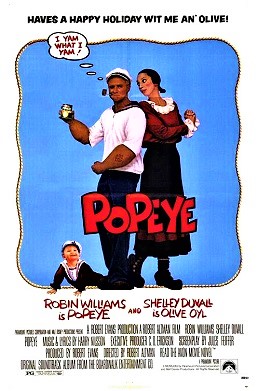
He's the man with the spinach can!  POPEYE, 1980
Popeye

A lot of pundits like to pontificate about comic book adaptions to film and how they have finally "made it big" in Hollywood. While this is not really wrong, it's not really right, either, as comic adaptions, like all cinematic trends, are cyclical. Things come and go, with a certain routine to the proceedings befitting an industry known for churning out the same thing over and over again until it is no longer profitable. (By the way, I mean the film industry, not the comic book industry. They'd never do that!) So for anyone over the age of 12, it shouldn't come as much of a surprise that the late 70s and early 80s were also rife with 4 Color adaptions in Tinseltown, including the film we'll be looking at today, Robert Altman's Popeye.

And I think it is crucial to put Altman's name before the title, because his influence is strongly felt in the final product. Altman was at the forefront of what was known as (and is still called today) the "New Hollywood" era, which was the period in American film history ranging from the mid-60s to very early 80s at the latest. New Hollywood was formed when the studios, reeling after the Paramount Case essentially broke their old "Studio System" lock, began to look for some way to reach the youth audience they were unable to communicate to with traditional fare. The big studio pictures of the late 50s and early 60s depended largely on spectacle -- improving and innovative technologies for pciture and sound made it possible to present epic period pieces or grand musicals on new scale. But audiences grew weary of these trends quickly, and after a few large scale financial flops (most notoriously Cleopatra, which remains the most expensive American film in history with inflation and nearly closed down Fox, but also Hello Dolly, which did good business but failed to turn a profit), executives were willing to try just about anything so long as it was cheaper. So they turned to the new generation of filmmakers, most fresh out of film school, and almost all inspired by the cinematic exploits of avant-garde contemporaries like those of the French New Wave. Names like George Lucas, Woody Allen, Sam Peckinpah, Francis Ford Coppola, Brian De Palma, Martin Scorcese, and Steven Spielberg all began their careers around this time.

The upshot of all of this is that there were new ideas being played out which bucked any type of conevtional filmmaking guidelines. Altman, best known for MASH, Nashville, and McCabe & Mrs. Miller in the first half of the 70s, had a certain trademark "style" which evoked classical autuer theory of the New wave. He became known for his world building, to borrow the comic book term, creating deep and involved settings for his characters to exist in, which were believable and tactile to the audience. He liked to use large, ensemble casts, and would often choreograph scenes in such a way that no matter where the eye looked, something was going on. And, probably most notably, Altman was known as an "actor's director," and he would frequently allow improvisation and let his actors talk over one another in an effort to portray realistic, well-developed characters -- often at the expense of the plot.

...

And so we arive in 1980 at Popeye. (And if you managed to read the previous three paragraphs, give yourself a pat on the back.) The film stars Robin Williams (his film debut) as the titular Sailor Man, complete with bulging forearms and squinty eye, and Shelly Duval doing her best impression of Olive Oyl. The cast is rounded out with character actors and bit players, cast seemingly less for comic timing than for their ability to embody their comic strip counterparts -- Paul Smith, best known as the torturer from Midnight Express (!) is the perfect Bluto, and Paul Dooley, who has appeared in everything from Star Trek: Deep Space Nine to the remake of Hairspray, looks like he was born to play J. Wellington Wimpy. Sweethaven is inhabitated by a gaggle of goofballs, including Olive's family (patriach Cole, his wife Nana, and her brother Castor), lots of burly sailors, and one nameless, bespectacled taxman who seems to always linger just out of the frame.

And what a town the little hamlet of Sweethaven is. Like a matte painting come to life, the town couldn't possibly exist, and yet, it does. With a few dozen homes and buildings crammed into what looks like one city block, it's streets winding and twisting up and down hills, Sweethaven is a fully realized setting. And Altman knows it -- he uses Sweethaven like another character in his ensemble, with each new setpiece bringing some new facet to the forefront. Bizarrely enough, this set, now dubbed "Popeye Village," is still standing where it was built in Malta and is a popular tourist spot.

Ultimately, though, this is probably why the film failed to reach a wider audience than it did upon release. Altman gathers his cast together, gives them a great place to play, and then lets them loose. The film lacks structure and locomotion, moving from one setpiece to the next in an episodic, almost discrete fashion. Ostensibly the film is about Popeye finding his long lost Poppa, but once he arrives in Sweethaven, things take detours frequently, moving along different tangential adventures with the whole gang. Audiences in 1980, weren't expecting this, and responded with poor word of mouth which eventually shut the film down and gave it a bad rep. Ths is reinforced with the opening gag, as the film starts with the credits of a Popeye cartoon, only to have the sailor proclaim that he's "in the wrong movie!" They wanted Popeye, but what they got was Thimble Theater.

The musical aspect of the film doesn't help either. A musical is defined by the showtunes being integrated into the story and helping to move the plot along, and Altman takes this to heart. The songs are grafted right into non-musical scenes, often cutting between them. Coupled with the lack of rhyme -- almost all of the numbers use repetition of certain phrases instead -- this tends to make the music unmemorable and at times boring, especially to a modern audience. "Food, Food, Food" is a quirky little number which is paired with a silly scene at the Roughhouse Diner, and "He Needs Me" is a standout ode which would later be rerecorded for Punch Drunk Love of all things. But beyond that, nothing is really all that hummable -- the classic "Popeye The Sailor Man" being an exception of course!

Despite these misgivings though, I enjoy this film. Altman wanted to create a live action version of the Thimble Theater/Popeye comic strip, and he succeeded. Robin Williams is game as Popeye, and while he may be hard to understand on his overdubbed mumblings, he certainly looks like a live action version of our favorite sailor, and his goofy grin is infectious. Similarly, Shelly Duval is perfectly cast as Olive, her affectations in speech and gait combining to create a living cartoon in all the best senses. Great touches abound, like when Bluto gets so angry that he literally sees red, or Popeye's classic "twister-sock" punch. Sure Altman loses the plot (not an uncommon New Hollywood fault -- see One From The Heart for reference), but everyone is having a lot of fun, and it soon begins to rub off on the viewer. By the time the last reel begins to unspool, and the "high seas" adventure episode kicks off, the audience is right there with the cast.

So if you are in the mood for something 4 Color that doesn't involve funny looking people punching each other... hrm. Let me rephrase that. If you are looking for something 4 Color which doesn't involve funny looking people punching each other and having feelings about it, and can make you laugh at the same time, then give Popeye a try. It's not perfect, but it's amusing and great to look at. And besides, if anyone asks what you did with your time, you can say you were catching up on your New Hollywood cinema studies.

Friday, July 13, 2007

4 Color Cinema

GHOST RIDER
Ghost Rider

I've never been a big fan of Ghost Rider. When I got into comics, it was Danny Ketch who rode the big chopper with his head on fire, but neither Danny nor Johnny Blaze (either with or without his Hellfire-spittin' shotgun) ever did that much for me compared to other Marvels. So when it was announced that Blaze would be the next Marvel hero to make the transition to the Big Screen, I wasn't terribly impressed.

And now that I have seen the film, in its extended version, I remain not all that impressed.

It's not bad exactly, as all the requisite elements are there. We have Johnny, a troubled and downright weird guy played with obvious enthusiasm by Nicolas Cage. We've got the super-hot Eva Mendes playing Roxanne Simpson, who doesn't have a lot to do except look pretty and help the plot advance -- so she's a success. We've got an fairly interesting villain in Blackheart, a rudimentary story (stop Blackheart from getting the MacGuffin), and some admittedly cool special effects. But it doesn't ever really come together into anything other than those individual parts.

Worse yet, it drags. Perhaps it's because of this extended DVD edition, but for a film about a guy who rides a motorcycle, things certainly do plod along rather lazily. There's some standout scenes with GR tearing up the streets or driving up the sides of buildings, but they are too few and far between to generate any sense of urgency or momentum.

There are some good points here. As I said, the effects are tremendous. Ghost Rider looks absolutely amazing, and the Hellcycle is no slouch, either. Cage is clearly having a lot of fun playing one of his childhood heroes, and Blaze, as a character, is better for it. But the performance is almost too off-kilter, and one begins to wonder if Cage is just screwing with us or if Blaze is supposed to be this loopy. Wes Bentley's Blackheart is about as well as the character can be done on film without being a riff on Maelbolgia from Spawn -- same goes for Peter Fonda as Mephisto(pheles). And Sam Elliot's turn as the Caretaker might ape every "grizzled old mentor" cliche in the book, but he does it with such panache that we don't mind too much.

In the end, though, those strong points cannot outpace the fact that the film is just not that exciting. And for a comic book movie, especially one starring a dynamic character such as Ghost Rider, that's one sin that's just unforgivable.

Friday, June 29, 2007

4 Color Cinema

Fantastic Four: Rise of the Silver Surfer

Fantastic Four: Rise of the Silver SurferToday is a pretty good time to be a comic book fan. As long as you are buying tradepaperbacks from Barnes and Nobles and discussing the critical merits of Watchmen to nodding sycophants who haven't read it, then everything's kosher. The upshot is that Hollywood is more than content to churn out pieces of 4 Color Cinema to a public willing to pay money to see them without having to worry about removing some sort of social stigma. The difference in marketting between Superman: The Movie ("It's not reverant to that stupid source material, honest!) and Spider-Man ("Remember those comics you read as a kid? SO DO WE!") is plain enough evidence of this.

Which gets us to the film I'm talking about today, Fantastic Four: Rise of the Silver Surfer. The sequel to the "bomb" original (we all should be so lucky as to make "bombs" which gross $330mil worldwide), the film picks up a few years later, and the FF are America's favorite celebrity superheroes. Reed Richards' impending nupitials to Sue Storm has the paparazzi in a flashbulb frenzy, but deep in space, a new threat is slowly making its way towards Earth, one that not only will disrupt the wedding but also literally destroy the world.

ROTSS is a remarkable film primarily because of how different it is from a lot of its fellow comic book film brethren. First off, it's a brisk film, clocking in at 94 minutes. This tight cut restricts bloated setpieces and super-emotions from running wild, as well as dictating a fast pace which works very much in the film's favor. Furthermore, it's rated PG, another oddity. This means that we don't get to see one our beloved superheroes have to restrain himself from beating his opponent to death or such. And trust me, that is not a complaint.

The characters are spot-on, much as they were in the first film. But while the original did suffer from a lot of necessary exposition, this time around everything hits the ground running. We go from the home life of the team to the arrival of the mysterious anomaly to all-out action without a lot of plot-explanation bogging it all down. The effects are nicely done, although Sue's colored contacts are a bit distracting. The Surfer is wonderfully realized, a lithe, silver missle streaking across the screen while in action, but a commanding presence when he speaks. Even the returning Doom gets a makeover which improves upon his original performance.

Most of the complaints I have are what I call "nerd complaints." Galactus, for example, was not what I expected. And would it have killed screenwriter Don Payne to toss in a "To me, my board!" at some point? But those are minor quibbles in the grand scope of things, and I try to put them out of my mind while watching a film like this. This is a different FF and a different Galactus, and as such must be taken on their own terms, not unlike an "Ultimate" or "All-Star" comic book.

This film is accessible and safe, a good family-friendly action adventure story. And really, shouldn't a Fantastic Four film be like that? This was a fun film. I had a smile on my face for most of the running length as my fiancee and I happily munched popcorn and watched the story unfold. (My fiancee, I should say, is not a comic book fan, but really liked both the first FF as well as this one.) It's not a serious, straight-laced affair, blaoted on its own importance and granduer. You have no idea how much I wanted to say those words about Superman Returns.

Fantastic Four: Rise of the Silver Surfer is a high quality, enjoyable, and fun movie which harkens back to the days when you could get a globe hopping adventure yarn in the pages of 2 or 3 issues of Fantastic Four for about 20 cents apiece. Highly recommended.